Showing posts with label prayer. Show all posts

Wednesday, April 14, 2010

Further Negotiations: Half Crazy: My Easter Miracle


Catholics believe in transubstantiation and transmogrification. When Catholics take communion, they believe they are receiving the body and blood of Christ. Literally. There are complex theological arguments as to how this is so.  For me, the least convincing arguments borrow the language of science. The arguments that elicit a “fair enough” response from me reference the various gospel accounts of the last supper. My favorite explanation of how this could be so, I came across in Wikipedia: The physical properties of a hat do not make the hat a hat. A brown felt hat is not known as a hat because it is brown, nor because it is felt, nor even because it takes the shape of a hat—an object could do all those things and still not be a hat. I am reminded of Meret Oppenheim’s Object, a fur lined teacup; it isn’t a teacup. Just like Rene Magritte’s pipe isn’t a pipe. No, a hat is a hat because at a metaphysical level, it is a hat. Its essence is hat. Fair enough.

As confirmation and first communion approached, I began paying attention to the consecration of the host. The communion wafer, by all accounts, is just a wafer until it is consecrated.  Something happens up on the altar.

Prior to Vatican II, the priest consecrated the host with his back to the congregation. (For us liberal types, Vatican II is a great thing—no more doom and gloom, greater transparency of what exactly is happening in the mass. It must have been difficult for those who didn’t pay attention in CCD to know what was what with it all going on in Latin. No wonder someone needed to ring a bell.) Now the priest consecrates the host facing the congregation. 

In my heathen mind, I understand this ritual as a spell, as ritual magic, and I commented to my husband, that Vatican II got the consecration of the host wrong, as ritual magic. The combined prayers of the congregation combine to call down the Holy Spirit. The priest is the locus of the binding together of prayerful petition and under the original rules the congregation and the priest formed a spiritual flock of geese, their energy focused on the wafers and wine before the priest and beneath the image of God on the crucifix hanging on the back wall of the altar.

But then I started to think about why the magisterium might have decided on this shift. In the old magic, God is called from outside the congregation and the priest. God does not reside inside even the priest, nor among the parish, but is called down from on high, alien to our daily lives. In the Vatican II ritual, God resides among the congregants and magisterium—priests and pastoral assistants, deacons—everyone on the altar and in the building working to bind together the prayers toward the purpose of consecration and communion. (My heathen mind can’t help but draw a parallel with the pagan circle of worship.)

Communion. Truly.

Confirmation happens during holy week. Holy week includes the Chrism Mass, Holy Thursday, Good Friday, Easter Vigil, and Easter Mass. Sometime prior to the Easter Vigil, candidates for confirmation must attend their first Rite of Reconciliation.

The Rite of Reconciliation, or confession, is one of the seven sacraments of the church. As far as I know, it is the one sacrament in which any Joe off the street can partake. Anyone may walk into a confessional during confessional hours and unburden herself. No one will check your Catholic credentials. My godfather (second baptism at my confirmation into the United Methodist Church) came home from the Second World War haunted by the face of the Jap he shot, and who shot him. He often went to confession at Sacred Heart. He came from a Jewish family, but had enlisted as Christian for a complex of reasons best known to him.

I scheduled my first confession with the intent of making a thorough inventory of my shortcomings, in the spirit of twelve step programs. I intended to arrive with a long list of every bad thing I’d ever done through commission or omission. That didn’t happen. I ran out of time and not only failed to make my list, but arrived late to the mass after which I had scheduled my confession. My intent was to discuss, among other things, my friend Christine with whom I had been close as an undergraduate.

Christine and I had attended the same Women’s Spirituality course with several of our closest friends. We each had our own reading list. I read Mary Daly, Christine Downing, a then-recent translation of poems to the Goddess Inanna, The Women’s Encyclopedia of Myth and Secrets. Christine was raised Catholic and read texts some of us (i.e. me) dismissed as patriarchal and arcane. We shared the books, all purchased at the Bodhi Tree bookstore in Los Angeles. (We all piled into the ancient Civic hatchback I had at that time—which I had to park carefully with a preference for hills because its reverse only worked occasionally and the car would only start with the throttle pulled all the way out—a hill is helpful if the throttle fails to get a stick shift going. The hatchback was light enough that I could push it uphill if needed and with five strong women pushing it, city parking was no problem at all.)

Sometime around graduation, Christine and my best friend at the time, Mary, had a huge falling out. Mary was upset because while Mary sat out a semester at home, Christine didn’t contact her, or something along those lines. Mary wanted allegiance. Disloyal and stupid, I shunned Christine under the flag Mary had raised: you can’t call yourself my friend and still be friends with her.  

We all graduated, went to grad school, got married, got divorced, and along the way, Christine gave birth to her first child. Her child died.

I didn’t send a card. I didn’t call. I didn’t acknowledge the heartbreaking reality of it. I didn’t give Christine or her child as much thought or care, as I should have. 

Over the years since, I have made a point of telling mutual friends to tell her I’m sorry without explanation: If you run into Christine, tell her I’m sorry.

High on the list of Shitty Things I’ve Done, that sin of commission and omission was on my mind when I scheduled my first reconciliation.

Sometime prior to my arriving late for mass and getting reconciled, Christine responded to a brief message sent via Facebook. I had asked if she thought I’d lost my mind in pursuing Catholicism. Her response was perfect: Faith isn’t about sanity. Faith is about choosing to believe things firmly rooted in the irrational—or at least in a part of the brain that doesn’t work chemistry problems. There was more. Enough that feeling like she’d accepted my apology was secondary to the sign I took her response to be—all of it together, her forgiveness and her encouragement, amount to one of those messages The Universe sends occasionally.  I am again blessed with having Christine in my life. I don’t deserve this consideration, but I’m willing to try to deserve it.

The Chrism Mass happens at the local cathedral. At this special mass, the Bishop blesses all the three oils that will be used in the Rites of the church, including Confirmation—for which Chrism is used. The blessed oils are then distributed to all the churches of the deanery and are presented to the individual parishes on Holy Thursday in a processional.
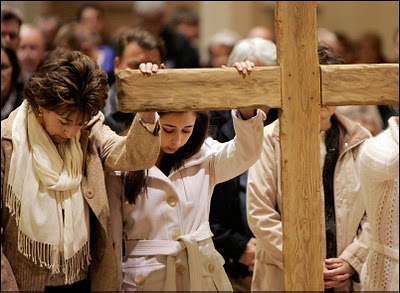
On Good Friday the veneration of the cross was beautiful. Person after person came up and kissed, or knelt and kissed, bowed, or placed a hand against the wood of a six foot cross standing in front of the altar. I pressed my lips to the side of the cross, foot level. When I returned to the pew and kneeled, I wept for the elegiac beauty of the ritual and the idea of living and dying for others. I felt the principle of self-sacrifice venerated—putting others before self—sacrifice for the sake of others. I’m sure my interpretation is not strictly adherent to the Church’s teaching, but the idea of being for others first is tremendously moving to me—more so than the idea of my eternal life being purchased by the death of another—though I’m sure that purchase of eternal life is exactly the point the Church would like me to take away.

I like to think I behave myself well, when I do, not because I’m afraid of Hell or jealous of Heaven, but because it’s the right thing to do. I don’t need metaphysical ransom to behave myself, which isn’t to say that I don’t often resemble the old lady in “A Good Man is Hard to Find:” if there had been someone there to shoot her in the head every day of her life, she would have been a good woman. Though, in my defense, the realization that we’re all equally beloved isn’t quite as hard won for me.

At the Good Friday mass, the priest lifted the bowl of communion wafers and I felt a burst of energy—imagine a tiny chrysanthemum firework going off silently and invisibly—the brown felt hat without the brown, the felt, or the hat shape. The small burst’s locus was the glass bowl of wafers. It came and went as fast as a flash bulb. My chest tightened. I took a deep breath and questioned whether or not the experience was real.

Was it real? If that’s what it feels like for the spirit to descend, what does it feel like to take communion after the spirit has descended into it? Had I experienced what I thought I experienced? Did I need to revisit my Prozac prescription?

Easter Vigil mass is when the Catechumen are baptized, the candidates confirmed.  The Vigil is the mass of first communion for all RCIA students. Easter Vigil is a long mass with nine readings tracing communion from Genesis forward.  The Vigil mass begins in darkness, lit only by the candles the Priests and congregants process in, lit from a bonfire outside in the Mary grotto. The congregants sit with their candles and the altar attendants light the Pascal and other two candles. The procession includes an incensory, and the air is thick with sacramental smoke. We sit in darkness and listen to the readings and choral responses.

In the liturgical year, Christ rises during the Easter Vigil mass. When the mass readings reach the risen Christ, the carillon chimes, a bell is rung, and all the house lights come up. It is a gloriously theatrical moment. I am fully present for the beauty of the ritual.

The Catechumen are baptized in the baptismal font—most by full emersion, kneeling in the water, their faces pushed into the water three times, in the name of the father, the son, and the holy spirit.  (Some only knelt while the Priest poured holy water from a pitcher over their heads in three draughts. Baptism by full emersion is optional.) The Catechumen exit to the conference rooms to change into Sunday clothes.

While the Catechumen change their clothes, the Priest blesses the congregants and the choir sings.

When we are all seated again, we are called up to the altar to receive anointing with Chrism as full members of the Catholic Church, our confirmation. (Chrism is oil— mostly olive, blessed by the Bishop and scented with sandalwood, patchouli, and floral notes. It is both dark and smoky and light with flowers. It smells wonderful. I intend to ask whether I can have some of last year’s batch. It smells that good. I’m a consumer of high-end perfumes, and this stuff is . . . wait for it . . . heavenly.) My husband introduces me to the Priest; I present my wife, Cave Mouth with the saint name, Dorothy. (There are two martyrs named Dorothy, but my Dorothy Day has not been officially canonized. Shhhh, it’s a secret.) The Father spreads Chrism on my forehead in cruciform, says some things, and we hug.  I experience a moment of pure happiness.

I am now a Catholic.

The mass continues with the consecration of the host.  (There is a moment in the liturgy when the Holy Spirit is supposed to descend. At that moment a bell used to ring. I’m not sure I felt the spirit descend at those times or not, but I don’t think it matters.) When the Priests outstretch their arms in a pushing gesture to bless the host, a rush of energy blows down the tops of their arms and from their palms toward the altar.

There was nothing to see, only the experience of an animated presence.

This time, I am certain of what I am experiencing. It is more than enough. Actually taking communion now seems beside the point, but I do with some amount of expectation. The wafer is simply a wafer in my mouth. The wine surprisingly good—much better than the crappy grape juice they serve at Methodist communion. I feel I have had my miracle, and I have no room to complain.

On Easter Sunday the candidates and Catechumens are no longer. We are Catholics. We take communion with everyone else. Unlike the Easter Vigil, which seemed to be attended by only the RCIA people and their guests, the Easter Mass is packed, standing room only. One of the three altar candles gutters out under the weight of the brass follower. When the Holy Spirit descends this time, it is perfunctory, a quick poof and gone.

Clearly, I have lost my mind. Maybe I’m not merely depressive; maybe I’m manic-depressive! Maybe I’m just flat out nuts and need to rethink my absence from the couch for the last decade. I don’t feel crazy. But not feeling crazy is a sign of genuine insanity, right? As long as I was fretting about being sound of mind and body, I was ok. Since I no longer obsessively fret…

With a deep breath to gird myself against my embarrassment and fear that I have lost it completely, I share this experience with the RCIA class at our regular Tuesday night meeting. The director offers reassuring information: people report light falling on them and all sorts of phenomena during the process. I am relieved:  mystical phenomena are part of the program. Ritual exists to occasion precisely this sort of experience. Sure, there are scientific reasons rituals produce results, but I’m not convinced that an explanation based in the sciences, hard or soft, matters. The experience is the experience. Crazy or not.

My friend Amelia, a yoga instructor and Buddhist, wants a debriefing mid-week. I tell her, I sensed the descent of the Holy Spirit. I think I have lost my mind. She asks if she’s ever told me about her Kundalini rising. When her Kundalini rose, she kept touching the top of her head to make sure it was still there: She felt like her head had been replaced with a swaying lotus bloom. Further, the corollary of confirmation for Buddhist is "taking refuge" in the Buddha, the Dharma (the teachings) and the Sangha (the community of Buddhists). When Amelia took refuge, the instructor blessed the graduating class and the air was so thick and electric with blessing that the rice she threw on the yogis danced in the air around them. No, Amelia said, you aren’t crazy; it’s real.

Light from light.

True God from True God.

Easter lasts eight days. It is a liturgical season like Christmas and Lent.

When I return to church for my first regular mass, still during Easter, I have a trembling feeling about taking communion. I’m afraid because suddenly it’s a really big deal. (We’re sitting out in the Narthex because our children are free-range and cannot be relied upon to sit still for any length of time—high energy, spirited girls.) This vague and dull terror is irrational. Still, my chest is fluttery as I make my way down the aisle.

Father R smiles brightly as he holds up the wafer: The body of Christ. I bow my head. (I like that he seems to take pride in our conversion and seems genuinely fond of me—even though, as you have likely guessed, I was the kid at the back of the room who always had another question.) I have made an altar of my hands for the wafer. When I put it in my mouth, the wafer itself seems to have the properties of wafer, but my chest is still fluttery scared and it seems extra important to remember to cross myself after receiving it. (I forgot to cross myself at the Vigil.) As I make my way back to the narthex where the families with kids who can’t sit still sit, the trembling feeling remains in my chest, but also I feel a light—basketball sized and glowing. Kneeling seems like a very good idea at this point. I pray. Hard.

For the life of me, I can’t remember what the prayer was; maybe it was just communion with the spirit.

Light from light.

True God from True God.

One in being.

In the car, I tell my husband about my experience. I tell him, I must be half-crazy. His answer is, Yeah, but it’s the good half

Aw, I think, that’s one of the reasons I love you.

Sunday, April 11, 2010

Further Negotiations: There’s Something Stupid in Every Religion –or- That Guy and Other Dumb Stuff


When my husband and I were arguing about whether or not our daughter and I would be attending The Shambala Center in Berkeley, California, my Buddhist friend Amelia wanted to know how I could possibly believe in all the stupid stuff associated with Christianity: The stories are predated by remarkably similar stories in other cultures and faith traditions. The idea of a red devil with pitch fork and horns. The elaborate accounting and jailhouse that is the Catholic afterlife of Heaven, Purgatory, and Hell, in which numbers of prayer hours net years off one’s sentence.


[Editor’s Note: Amelia respects Christianity and the beliefs of Christians. She believes the purpose of religion is to help varieties of people reach an understanding of God.  As a Buddhist, she believes Jesus is a guru among the many gurus—a great teacher who has lead countless billions to a deeper understanding of God. She does not believe Christianity is stupid. Our conversation related here was not a serious one, but another moment of irreverent levity in many we have shared in the overall context of a great respect for one another’s beliefs. Obviously my memory is subject to the vagaries and unreliability of memory; Amelia tells me that dumb guy is a she, not a he.]

At that time in the bookstore of the Shambala Center, there was a print or painting of a demon with a mouth full of huge fangs hung near the ceiling above the bookshelves. To me, it looked kabuki—curling graphic stripes of primary yellow and red, with that odd jade green and gilding particular to some Asian art.  I had asked Amelia about it. Who or what is that?!

She had answered that it was the demon who in the afterlife rips the jugular from the perverters of the dharma with his long, frightening fangs.

In response to her questions about how I could believe that dumb stuff, I asked, Oh really?! What about that guy?!

This response seemed to satisfy both of us.  There’s something stupid about every religion.  

There is an element of superstition and the bizarre to every faith practice—the compulsion to cross oneself when an ambulance passes, my mother-in-law’s panic around our slowness in getting our children Christened (as if any God we believed in would condemn the souls of babies to anything less than Heaven), fish on Friday (as if fish weren't meat), vampiric demons, dietary restrictions, those weird Ayurvedic practices involving cleansing internal cavities of one sort or another (with all due respect to the netti pot, which must certainly be a Divine gift to those with sinus issues). Any one practice, any one idea, any one story taken out of context can be held up to ridicule.

Then and now, my feelings are these:

1.     It isn’t important what I think; it’s what I do.

(That’s a challenging precept for me. I’m all about language. The best gift I have to offer is my ability to write. Sure, I can bake cookies, I can show up for the St. Vincent de Paul warehouse weekend, I can write checks, I can volunteer for all manner of civic and church events, but the first fruits are right here. Writing is an intellectual exercise. Sure, I try to work from trance, to leave myself a vessel, and otherwise attempt to be a conduit, but my brain is all over this. And the brain is a dangerous organ because it can be convinced of anything. It’s the heart that tells the truth. Is writing doing or being? At the least, I try to make writing be about being. For much of my life, it has been while writing that I am closest to purely being, which is one way to know I am following my bliss—or living an inspired life— or following a greater plan.)

2.     It is important for me to have a faith practice, more important than having faith.

Faith is good, but without practice what is it? I say religion that is merely belief is superstition.  The Church Lady has no faith practice beyond attending church and praying. She certainly doesn’t treat other people with Christian charity. I’d be willing to bet she doesn’t vote with the common good in mind either, but with a preference for punishment and judgment. Practice, though, practice creates a change in my self and the world that is demonstrable. It is the thing I can point to when people ask, what’s the point of religion?

The point of religion is the practice of compassion, forgiveness and love in one’s interactions with the world. Feeding the hungry. Comforting the sick. Loving one’s neighbor as one’s self.

It is through the discipline of faith practice that I most easily experience the divine.

The Catechism and the Nicene Creed (which Catholics repeat during most masses) feature a belief in the afterlife—“we look forward to the life to come”—and when most religious talk about their belief, they eventually wend around to “eternal life in communion with the Father and the Saints.”  I wouldn’t mind that; it sounds great. The afterlife does not motivate me. What kind of person would I be if that were my sole motivation?

I like to think most people chose to be good because it’s the right thing to do whether there’s a reward involved or not. Sure it’s a good thing to return the lost wallet for the reward; it’s an even better thing to just return it because you can imagine how you’d feel if you lost your wallet. I don’t need a reward. I just want everyone to be happy and kind.  It would be fine with me if I died and nothing happened. Especially if I knew I’d lived a good life.

3.     The practice of choosing to believe in those things that blow open my heart to an experience of myself as part of a mystery bigger than myself is a good thing. If a belief of one sort or another guides me to a better, healthier, more authentic version of myself, it’s a good thing in which to believe. So, while I have yet to memorize the Nicene Creed, I say it along with the parish in the hopes that— in choosing to believe— my rational mind will eventually catch up with my heart.

4.     Prayer works. Every specific request I’ve made has been granted—to my surprise and embarrassment.

I’m surprised every time a prayer is granted, even though I know beforehand that, so far, God willing and knock wood (yes, I'm aware of the irony), I’ll get that for which I’ve asked; all my previous petitions have been answered in the affirmative.

I’m embarrassed because belief in supernatural phenomena (prayers being answered) and interaction with supernatural entities (talking with dead relatives or asking God for stuff) are activities most often shared by paranoid schizophrenics and manic-depressives. (To the best of my knowledge, I am merely depressive.)

Five years ago we were living in a dorm room with our two-year-old daughter in the San Francisco Bay Area. Beloved had taken a tenure-track job at a school just east of the Caldecott Tunnel. We drove through The Canyon and dreamed of a cabin in its dense wood. I pored over real estate listings and found a property we could afford if I went back to work. It was an hour further outside the Bay Area proper. A cute little early twentieth century house with a huge lot by California standards. It was 600 sf and had no closet. Not even a broom closet. It cost $250,000. There was no lawn. The house next door had two threadbare sofas on the front porch and a car on blocks at the curb. On that weekday afternoon, several men who didn’t look like college professors or industry types sat on the couches watching us warily as the realtor showed us the house.

(Like many Americans at that time, we were deep in debt and had no net worth; in fact, our net worth was over fifty grand in the red. We wanted to own a house because we had a child. We were tired of paying out thousands a month on rent and not accumulating net worth. One of the reasons we were so strapped was a stubborn refusal to live in neighborhoods in Los Angeles that we could afford. If one only lives in accommodations costing less than thirty percent of one’s income in Los Angeles, one will be living in a neighborhood in the Valley, which is not Los Angeles, or in South Central, which is not very safe. )

In January, my husband swore we’d have a house by the end of the year. To create good karmic cause for a house, he organized a school-sponsored Habitat for Humanity build. He said there was no way the Universe would give us a house, if we didn't help other people get houses. For my part, I prayed for a house every Sunday during mass.  We closed on our house in September of that year.

Sure, it isn’t definitive proof, but what is? I like to think the Universe moved to answer our desire in the affirmative because we humbly asked for what we wanted and took steps to get it—all on terms the Universe probably is more likely to understand and value.


Friday, February 5, 2010

Further Negotiations: Prayer


 Sometime prior to 1998, my best friend Ken, Jay—his lover of many years—and I sat on mats in the yoga studio on Larchmont, which offered free introductory classes once a month. (Larchmont is a street and a shopping district in Los Angeles just south of Melrose Avenue and adjacent to the big houses lining Highland Avenue.) We were listening to an instructor talk about yoga as a fitness and spiritual practice. She demonstrated some showy asanas or poses—inversions like head and hand stands, the gravity defying switch from down to up dog, and the pretzel-like balancing act of bakasana, crane or crow pose. (I eventually was able to hold bakasana, and if you’ve seen the size of my behind…well, getting it airborne and balanced atop the fulcrum of my arms is quite an accomplishment.) 

The instructor introduced a petite woman who spoke about what yoga meant in her life. She was one of those twenty-something sylphs who does not yet look like an adult. She had been raped, and yoga had helped her to live in her body again. She demonstrated a sun salutation, bridge (a backbend), and spoke for a while in a headstand leaning against the wall.  The instructor concluded the talk portion of the freebee with more discussion of how yoga helps to fuse the gap between mind and body, how it allows people to get out of their heads and live in their bodies. At some point prior to a recititation of the discount packages available, the petite twenty-something folded slowly down from the wall and quietly excused herself.

We began the workout portion lying on our backs while the instructor encouraged us to feel ourselves in our bodies. At this time I was a size 24 and had been for about a decade. I was and am fat, pleasantly fat, but fat, not plump or big-boned, fat—the polite Midwesterner, my husband for example, would call me a “big gal.”

Inhabit my body? Why on earth would I want to do that? My reaction is visceral: the sort of reaction one would expect from a woman who had lived most of her life deep inside her head pretending that her body had absolutely nothing to do with who she was or how people treated her despite sometimes shockingly cruel evidence to the contrary. I shook it off, like trying to shake off spiders.

Inhabit my body? Are you out of your fucking mind?

The class concluded. We rolled and put away our mats. We went to lunch at the Greek place up on the corner. I ordered the gyros with tzatziki. I did not think about yoga again.


My husband and I rolled along—planned a wedding, got married, and were married for four years—before we decided to have a child. The pregnancy and child became the focus of my obsessional thinking. I resolved to be the best pregnant woman to have ever conceived. I began walking three miles three times a week at the USC track with my husband and his best friend, Johnny. I signed up for Bradley Method, hospital-sponsored, and doula-led birthing classes. I hired a doula. I read a small library of childbirth and infant care manuals. I bought my first fitness magazine, Fit Pregnancy. Because more than one source recommended it, I paid upfront for ten pre-natal yoga classes on Larchmont. Then I paid for twenty more classes and received an even deeper discount. I attended every class and managed to be the ridiculously gravid woman who proudly announces from her mat that she is forty-one weeks pregnant.

In my zealotry it does not occur to me that a person who has yet to bridge the gap between her mind and her body will not be able to insure a successful birth through what is primarily an intellectual and ego-driven effort. My first child is delivered via caesarean section in the shadow of the Harbor Freeway, downtown at Good Samaritan Hospital.

Ouch. And the c-section recovery was no picnic either.

New obsession: I must model health for my child. I must change my life. I must remake my world and my place in it so that my child will know how to be healthy and loved and at peace in the world. I’m sure I’m not the first or last woman to make those vows while intoxicated with the scent of newborn skull.

I lost almost 100 pounds. (How, you ask? A herculean task, don’t let anyone tell you otherwise. For me, that task involved spending several hours a week at the gym, four hours a week in meetings at UCLA’s Risk Factor Obesity Diet Program on Saturday mornings, and several more hours a week walking my first born around Los Angeles in her stroller. I weighed and measured all my food and calculated the calories. I calculated the calories burned—at 600 calories an hour, swimming is the best calorie per hour activity other than cross-country skiing. I calculated calorie intake minus calorie output per week with an eye toward hitting a calorie number below the calories needed to maintain my weight at 100 calories per pound. Under no circumstances make yourself miserable eating for a 120-pound person if you weigh over 200 pounds—that’s just crazy making—and you’ll feel like shit while you lose your mind. And that, my friends, is the only way to lose weight and maintain its loss—you do that and continue to do it for the rest of your life. It’s the “for the rest of your life” part that trips everyone up—and I suspect that’s part of the popularity of the 12 step programs—but I digress. There you have it: the secret formula.)

It took two years. I was finally the same size I wore in high school, not small, not even close to small, but I could pass for big boned, rather than fat because all that exercise tightens up stuff that would be lax otherwise.

I hold bakasana indefinitely. I work on doing a headstand. Butter and oil leave our lives. Cabbage replaces rice. Fruit replaces bread. I feel good.  I practice ujjayi breath during all forms of exercise, save swimming. (According to Wikipedia, “This breath is especially important during transition into and out of asanas [or] postures, as it helps practitioners to stay present, self-aware, and grounded in the practice, which lends it a meditative quality.”) I experience the love of God while prone on my yoga matt listening to an instructor chatter about being present, self-aware, and grounded. My ujjayi breath joins the chorus of ujjayi breath in the sweat-smelling studio.

(Size 14 according to Lane Bryant, but no one else, I was sitting in the dry sauna at the 24 Hour Fitness next door to Amoeba Records in Hollywood. It was Friday night and this woman comes in. This woman is a type. This is the type: she has been beautiful all her life and her expectation that she will be treated exceptionally because of her beauty is deep and inchoate. Now, pushing 50, she has to work harder to be beautiful, maybe for the first time at all, and there is panic welling somewhere deep and next door to her expectations for her life. But, part of being that woman is that those sorts of thoughts aren't acknowledged, maybe ever. So, she sat down across from me, and I could feel her assessing me  my eyes were closed I was doing ujjayi breath  sinus problems. Then she says, excuse me, I don't know what your journey is, but you know I stopped eating bread and it has changed my life... and on she went... she had a date later, she liked to work out to get in a good headspace before going on a date, and on and on, on the premise that I needed to lose weight and needed her help, I was Ugly Betty and she would be the magic life coach who would sort it all out for me. Fuck her. After a few I just like to breathe quietly in here had been ignored, I tried to practice compassion. By the time she left   thank God!   I understood she was just trying to build herself up for a blind date. Still, fuck her.)

More recently, our RCIA class gathered for one of our Tuesday night meetings at a neighboring parish to hear Sr. Mildred speak about prayer.  The chapel of this church is lit to a low glow. There is a statue of Mary draped with several rosaries of varying quality—cheap plastic beads, pressed rose petal beads, semiprecious stone beads. (In my irreverent mind, I am reminded of Mardi Gras beads and imagine Mary happy on Bourbon Street.)  The room is absent the bank of candles I associate with Catholic churches. (All the churches in Europe had banks of candles back in ’91.) There is a lectern, a small folding table, and rows of upholstered metal stacking chairs.


Sr. Mildred tells us that prayer is the means by which our quotidian physical experience is brought closer to the extraordinary plane of the spiritual where God, Mary and the saints exist. She moves her hands in a horizontal stripe, one atop the other running parallel about six inches apart, from her right to her left. The point of prayer, she says, is to bring the two together. This time her hands do not run parallel, but converge on her left at a disappearing point on an imagined horizon. (I am reminded of the painter, Mark Rothko   and Thomas Merton, his friend   and how for a while I was obsessed with the metaphor of landscapes  not in any scholarly way, but as an object of meditation and fodder for my own writing.)

Until I listened to Sr. Mildred, my understanding of Catholic prayer was limited to what it must look like to many Protestants looking in: Catholics recite from prayer cards, Catholics pray the rosary, Catholics participate in call and response prayer during mass, Catholics do not talk with god except in extemporaneous requests for the blessing of church sponsored events. Catholics do not converse silently with God: they offer praise aloud and in groups.


Sr. Mildred reminded me of another nun who spoke at a Women’s Center-sponsored conference at the University of California, Riverside in the mid-eighties. As I remember it, the speaker at the UC Riverside event was the directress of a Los Angeles halfway house for women leaving prostitution. She spoke about the day-to-day operation of the house, interspersed with individual success stories—she could have been any random type of progressive giving a presentation on the socially valuable work of her organization. Then she told how above her desk in her office is a picture of a woman of color from another culture. This picture, she tells the crowd, is her picture of God—where others would hang a crucifix, she hung the portrait of a woman likely wearing kente cloth or the ubiquitous Peruvian hat with braids. The Sister tells us that once speaking with one of the women living in the house, the woman asked about the picture. Hearing the Sister’s explanation, the woman began crying; it was the first time she had conceived of a cosmology in which a woman like herself could have anything to do with God.

The current Catholic definition of prayer, Sr. Mildred tells us, is “conversation with a real and present God.” She asks us to consider the word conversation, which implies both expression and reception—talking and listening. We forget as Catholics, she says, to listen to what God needs to tell us because we are so busy asking for things. She presents the various types of prayer: chant, novenas, the Lord’s Prayer, the rosary, petition, meditation, journaling, prayer cards, etc.  In this discussion I am moved because she confirms as legitimate Catholic spiritual practice those forms of conversation with the divine with which I am most comfortable and practiced: journaling, meditation, silent conversation with God.

So I have begun to try something Sr. Mildred suggested: simply listening. Not meditating on the yoga matt, simply allowing myself to experience and appreciate health as an expression of grace—having gained back every ounce and then some over the last five years, my yoga practice and experience of good health is limited at best—but praying silently with a question mark hanging over my head. Instead of asking for God’s will to manifest in my life and the life of my family during the offering of petitions during mass, I make myself receptive. I dial the number and leave the line open.