Friday, May 21, 2010

First Fruits: Not Barren

We are called to offer the universe the best of what we have to offer. This arrangement works out nicely as it is often in our best work that we find our most joy. Even before I could read, it was clear my greatest talents lay in language. I attempted my first novel, a romance, when I was in third grade. It was three typed pages long. It was horrible and endearing. The following year, I wrote doggerel poems for my spelling words instead of sentences and read a few dozen Nancy Drew novels. Writing is my succor and in it, I am saved. And yet, the idea that I am meant to write whether anyone else thinks so or not, I have struggled most to accept. More than my mortality—it is easier to accept that I will cease to be, than it is to accept that I am meant to do something that might not be exceptional, but that even to me might be merely acceptable.

Acceptable to others? Accepting that following my calling might be humiliating at best has been its own struggle. The calling is what it is. The harvest is almost beside the point: the planting and tending make the garden. There are no fruits without gardening. The choice, then, is between productivity and barrenness.  Better to yield a few withered yellow zucchini than maintain a patch of rocky soil.

During my late adolescence, I had episodes of major depression, dropped out of college and dropped back in.

Slogging through the fog of unrecognized and untreated depression is maddening in itself. On top of the symptoms of depression itself—insomnia or exhaustion or despair or everyday sadness that is notable only in that it never lifts—not knowing what is wrong with oneself is an extra layer of madness. The internal dialogue of unrecognized depression is this: if I can just get enough sleep, I’ll be able to whatever, or if I stay up all night working on this since I can’t sleep anyway, that will help (never mind that it’s the third night in a row), or I’m failing. What’s wrong with me? Why can’t I wake up in the morning? Why have I suddenly become an idiot? Why don’t I understand this? Why isn’t anything sticking? I read and nothing gets in. Everything—reading, conversation, people’s names, experiences—washes over the depressed and is gone; nothing is retained. Living in a fog, the depressed can’t see what depression is until she’s left it and is standing on a hill somewhere looking down on its dark mass. As long as she’s in it, her visibility is limited. Occasionally something emerges from the fog or she stumbles into a clearing, but mostly she lives in it, until she doesn’t. Unless she gets treated.

Writing was always the clearing. As long as I was writing, describing the experience, I was safe. Everything else might be a stinking smoking compost pile, but within the context of creative work there was clarity, purpose, accomplishment, even the occasional joy. I never sang merrily with the forest creatures, but the sunlight filtered through the trees revealing the rocks, grass, trees and flowers in the hyper-focus of the bright parts of chiaroscuro.

The problem with creative work that saves us is that it often saves no one else; that is, it sucks. It is interesting merely as the byproduct of some trauma. It often is incapable of standing on its own in the company of the pros. It is precious to us and us alone. If it accomplishes something of value, it is as curiosity not as masterpiece; the literary equivalent of coffee mug scrawls and the twee odes to catastrophe or God sold as framed prints in mail order catalogues.

On a pleasant afternoon, probably a Thursday because we were gathered for poetry writing workshop, some classmates and I were standing on the back terrace of the English and Comparative Lit Building under the shredded bark of eucalyptus trees. I told them ruefully, that I was an idiot savant. I was absolutely certain that the only reason I was accepted to graduate school was my talent: having a spotty undergraduate record and the lukewarm support of my undergraduate mentor, my portfolio must have been the only thing that got me in—that and a letter of recommendation from an important editor. My work and I had charmed him when he took up the post of my mentor, who had taken the obligatory post-tenure tour-of-Europe sabbatical.

When I still felt doors opening along my path as an undergraduate, my editor/teacher/friend agreed to an independent study consisting entirely of sending out poems for publication under his direction. I sent poems out. I got a few published in places astonishing for both their cynicism and lack of editorial standards—Win cash! Poetry contest! – and a few in places astonishing for the chutzpah of their editor/publishers, who were not much older than myself—zines associated with the punk rock subculture.

I did my best in graduate school, but when graduate school was over, I had impressed no one, least of all myself.

I knew I’d had enough of whatever it was that was the graduate school experience. And if that meant I wasn’t going to be a writer, or if it meant I’d be a different kind of writer, so be it. I was exhausted and directionless. Creative work had soured with the attempt to “professionalize” it.  Somehow being a professional writer had become entwined with learning how to teach recalcitrant teens how to write short essays and research papers.

The career center had no sage advice beyond referring me to the job board and suggesting I attend one of the corporate recruitment days. I couldn’t live off the job board offerings, and I didn’t understand how a person with experience mostly in music store sales and university physical plant work would manage to land a corporate position of any type, especially in the thick of the recession that was 1992. (In Orange County, California— an area that includes the coastal wealth of Newport Beach, Laguna Beach, and Balboa Island— people were so desperate, they were voting democratic.)  I didn’t know what to do next.

Sitting at my desk in the living room of an apartment adjacent to what we called “Drug Street” in Santa Ana, I continued to write halfheartedly, promising myself that it would save me.  It would change everything: All I had to do was continue to write and my life would become what it should become.

I didn’t, but it did.

And now, here I am, twenty years later, having tried to find my calling down other avenues. I never really stopped writing. There were always journals. There were extension courses. Novels begun and abandoned. A screenplay about meth addiction and prostitutionbegun under the direction of friend whose own gambling and other habits seemed strangely similar to that of our protagonist—also abandoned. Forays into writer’s groups that fizzled out. Letter writing on a prodigious scale. I never really stopped writing, but I never really started either.

I was busy making a living. Getting married. Having children. Trying to find a career. All of those goals are still in process.

Some writing students enter and leave school with a kind of crippling grandiosity. Some students like myself. I never subscribed to the ridiculous ideas about artists being subject to rules different than mere mortals. Sure, there’s much to be learned along the road of excess, but dissipation as vocation just seemed stupid to me. My particular Janus head of doom consisted of grandiosity paired with its ever-present twin, self-loathing doubt. The grandiosity amounted to a delusional belief in my talent as something far different and superior. The truth—that talent is as individual and as common as, well, individuals—floated at the top of a pool of self-loathing around work ethic, procrastination, self-doubt and fallow periods of creativity. Accepting that what makes a writer is work has been hard won for me.

When Dustin Hoffman and Gene Hackman were promoting their movie Runaway Jury, Hoffman told an interviewer that being an actor starting out in one’s career is hard because you don’t know if you’re conning yourself. The same can be said for writers. You don’t know if you’re conning yourself at precisely the point when blind faith is most needed, that is, when you have no publishing history to assuage worries that whatever made you think you were entitled to a career in writing was wholly misguided and delusional. At precisely the moment when you’re called to work harder than you’ve ever worked in your life, the idea that all that hard work and poverty might net nothing slouches in the corner snickering, smoking a Gauloises. The grandiose can’t help but ask what the point is, if one isn’t going to be A Great Writer. Juvenile. Embarrassing.  But there you have it.

So, there is a pruning process during which the number of writers whittles down to those too crazy to do anything else or too cocksure to admit any other possibility.  I fell into neither category. I just kept writing or sublimating creative energy into other outlets thinking that the world of real creative work was something outside and beyond whatever it was that I happened to be doing at the moment.

Like being in love, having a baby provides an important circumspect vantage point. Having produced a living human being, I’m less inclined toward preciousness regarding my creative work. I’ve made a person: what do I need to prove beyond that? The people I’ve created are a source of wonder and are more remarkable every day. What do any concerns about one’s career status ultimately matter? We are here briefly. We don’t know what’s important until after we are long gone from this life.  Think in astronomical terms. Or geological. What remains of us? What remains of what we do or of what we fail to do? Our actions are infinitely important and infinitely unimportant.

For this lifespan in the millions of years that is life on earth, what will I offer the universe?

All I am capable of offering.

Friday, May 7, 2010

Further Negotiations: Glamoured


When I was in my early twenties my confirming church, First United Methodist, called to wonder where I’d been and if I was still a member. I told the caller that I was no longer worshipping a white male god; I was a feminist pagan.  In my social milieu, people wore jackets customized with emblems, slogans, and images that broadcast one’s worldview. Some wore black leather with skeletons dancing across the back. Some wore Air Force hooded fatigue coats with red, white and blue bulls eyes carefully painted in primary acrylic. My Levi’s jacket had a white women’s symbol, the tail an upside down cross, the circle a peace sign, all outlined in metallic gold. Around this central motif twined a five- candled wreath of purple flowers, green leaves and curling vines. 

I could probably wear this jacket, if it still fit, without much consternation. It summarizes nicely where my spiritual head is at. I do not subscribe to a stern father model of God. I do not believe God is gendered. I do believe that “feminine” energy is the source of creation—how could it not be? —Why would a universe organize the visible world around a symbol system that is diametrically opposed to the spiritual world? I don’t think it would. Though, admittedly, the upside down cross now strikes me as disrespectful, juvenile and overly simplistic.

In the 80s an upside down or X’ed over cross, such as those on Bad Religion T-shirts, sought to comment not on Christ or the crucifixion, but on the organized religion the cross symbolized to those of us up on tip toe peaking in the church windows — or kicking at the turf from a safe distance across the street.  Tammy Faye Baker, Robert Tilton, Billy Graham, Jerry Falwell, Pat Robertson, the Trinity Broadcast Network’s talking, weeping, and painted heads—the airwaves were full of an image of Christianity that was obscene and far off Gospel message. Sex scandal after scandal involved “righteous” men who had many judgmental and moralizing opinions about the sex lives of others.  Jerry Falwell declared AIDS a plague wrought by god to punish sin. While they weren’t busy opposing the Equal Rights Amendment and proclaiming God’s hatred of homosexuals, they were busy laying the groundwork for a prosperity gospel—they were happy shiny people who were happy and shiny because God wanted them to be the happy shiny owners of air-conditioned dog houses. In the thick of it Bono chided from the concert stage, “My god ain’t short on cash, mister.” 

For people raised outside an organized faith tradition in which they otherwise might have familiarity with the Gospel message, Christianity looked pretty vacant: self-righteous, self-involved, narcissistic, money mongering, whore mongering. As the “Religious Right” aligned itself with the Republican Party, the jokes about how the hookers don’t like to work the Republican Convention because those guys are really twisted when it comes to their predilections applied equally to Religious Right practitioners. They were one; upon regressive politics and policy they could both agree, and upon the subjugation of women they could both agree. By extension, the Democrats embracing their sexuality and essentially fallen state, had a healthier relationship with sexuality all around and weren’t dabbling in anything half as dark as the kinky freaks across the isle.  Or so it appeared to many others and me.

For those familiar with the Beatitudes or the Sermon on the Mount, the spectacle of weeping and/or penitent millionaires was simply obscene. I suspect I am not the only person who turned away from Christianity when its public image coalesced with the Technicolor show that was the Religious Right. (Thank God for Bill Moyers and Sister Wendy!) 

When I turned away, I turned toward a practical application of The Beatitudes—which in my mind means some form of socialism or a form of pure Marxism divorced from the nastiness of some of its previous incarnations. For instance, I once read about an agrarian province in India in which universal healthcare and near 100% literacy are the norms. No one is wealthy, but no one has a starving intellect or belly, either. Like Steinbeck’s preacher, I like to think that once and only those needs are met, spiritual hunger will lessen as well. It’s hard to believe in a benevolent Universe if your starving child lies in your lap too weak to swat flies. 

Mysticism is my natural inclination. I like to think about God much more than I like to do God’s work. So I spent a lot of time thinking about God as understood apart from the Religious Right—as far apart as I could get. My bumper sticker at the time: Sappho’s Coming

My sister is making me a rosary to commemorate my confirmation into the Catholic Church. It will be made of garnet beads. She isn’t making it with a crucifix; she is opposed to crosses and crucifixes. As she explained in a recent phone call, “It’s like memorializing Holocaust victims with shower heads. It’s the least important part of the story.” (I’m certain a phalanx of Catholic priests would disagree.)  She intends to include a goddess figurine where the crucifix would normally go. I see no problem with that. None. I am a cultural relativist. My god isn’t their “God.” “They” are people who are not cultural relativists. My god certainly isn’t some bearded and middle-aged 16th century Italian with white hair. My god is nebulous: The Universe. My god is everything that reminds me I am infinitely insignificant and infinitely connected in relation to everyone and everything else. My god is an acknowledgement that none of us mortals know what god is or isn’t. Not me. Not the magisterium. Not the priesthood. Not the Pope. S/He who cannot be named is my god.  

Around Easter I made a new friend at work, Mote It Be, whose own blog (because he’s a big fat copycat) can be found at http://noobiewicca.blogspot.com.  Mote It Be made no secret of his interest in paganism. He quickly became my friend. This relationship has raised questions. If I am drawn to a Wiccan newbie right as I am learning the Nicene Creed by heart, what is the Universe trying to tell me? If I am drawn into an intense friendship with a man who is everything I have renounced for the sake of my marriage, in what is the Universe trying to school me?

This morning my youngest daughter carefully applied lipstick and sat in my white leather living room chair cradling the lipstick in her hands. The lipstick was tucked succinctly into the purse case it lives in, usually at the back of big sister’s bathroom drawer. (Big sister inherited all of her grandma’s makeup.) The purse case this tube lives in once held my only tube of Chanel lipstick, which cost somewhere beyond $20. The lone and prized tube of Chanel ate it when big sister drew on a wall or all over her clothes or completed some other tragic comedy years ago. Mote It Be is my tube of Chanel lipstick.

It has been nine years since I was free to get up in the morning and decide my day free of the influence and obligation of a committee of domestic terrorists. I am on-call 24 hours a day. I chose that. I still love what it means to be a mother and wife, but nine years is a very long time—long enough to forget that it is not unreasonable to ask for and receive several hours a week to one’s self.  It is not unreasonable to maintain friendships that have nothing to do with one’s husband’s professional contacts, one’s children’s playmates, the network of mommies and daddies and neighbors and colleagues and church friends that make up the routine life and friendships of the stay-at-home mom. Mote It Be, then, is my tube of Chanel lipstick, garnet with flecks of bronze and smelling like, well, Chanel lipstick (though he actually smells like some spell oil intended to incite lust—smoky, sweet and masculine essential oils).

Over the last few years on Face Book, I have been gathering my friends who knew me when nothing about me was a secret. Mote It Be is the kind of friend I used to have before being someone’s wife and other people’s mother primarily defined me. Being known, it turns out, is important. Being known for the person you truly are when you are without fear, humble and naked before the universe is important because being that person and being ok with being that person—that buoyant homeostasis—like savasana—is one of those times when the universe bends down and kisses your forehead tenderly. Profoundly connected, whole, at one.

I have been drawn to Catholicism from the start because it echoes paganism. The liturgical calendar follows the seasons of birth, growth, and death—maiden, mother, crone—at least in the northern hemisphere. The Virgin Mary’s primacy in Catholicism is particular to Catholicism, but it is also an echo of the Goddesses that historically precede her and an obvious cooptation of the fertility cults the Roman Empire supplanted. (According to the Encyclopedia of Women’s Myths and Secrets, several Madonna and Child statues in the United Kingdom, when examined carefully, reveal themselves as pairs of female figures.) Communion has its parallels across more than one faith tradition, including paganism. Voodoo is an amalgam of Catholicism and West African faith practices. And in these ways, Catholicism holds more attractive symbolism than do the mainstream Protestant traditions with which I’ve had experience.  My heathen soul is glamoured by the allure of The Mother Church.

Sunday, April 25, 2010

Loving Someone


Holding hands in the twilight of the Fox Movie Palace in my hometown. I’m in sixth grade and prepubescent. I am holding hands with Mike Dahl and suddenly we’re kissing. It feels like the heavy velvet curtains on the proscenium have turned to gauze and are falling, slow-mo in billowing liquid folds forever down and down, sinking, the endless swoon that becomes nothing more or less than what it is: the kissing of virgins. 

The attic in The Hunger. Catherine Deneuve weeping atop the coffin holding David Bowie’s still animated body—doves cooing, a breeze lifting the gauzy drapes. 

Countess Olenski and Archer sharing a carriage ride. Archer kissing her wrist with the delicacy and care and bated breath normally reserved for parts that change color with kissing. Countess Olenski asking, “Shall I come to you, Archer?”

The glorious breathless waiting, vulnerable and abject, for the telephone call, the text message. And it being there, exactly when one could expect it reasonably to be.

The last is the only one that stands up to the demands of adult life. It is the only one that can hold a candle to marriage. 

I am married. Not just a little. And not even because I want to be anymore. I no longer know where one of us begins and the other ends. I no longer know how I would begin to excise my beloved from my heart, even when I want to, even when I spend hours imaging myself the executioner of a Viet Cong prisoner, arm outstretched and ready to fire.

And the last example is intoxicating only because it holds the promise of a release from being bound, against one’s will, against all rationality to another. You can’t shoot them, and toying with another only reinforces the bond.

Deep and inviolate.

Every argument I can make against loving my husband, every move I make to extricate myself, every scenario I play out, only serves to make more clear the horrible and beautiful bondage of the heart that has been given over completely to loving someone. 

Who has forgiven me more?

Who has loved me more?

Who has bourn more? 

Who has been as steadfast, as trustworthy, and as ready to sacrifice all for me?

Who has been all that to me and laid beside me, winded and sweaty, stroking my hair and kissing cathartic tears off my cheeks?

This may be all I will ever know of heaven.

It may be enough. 

Thursday, April 22, 2010

Being a Fat Woman

Being a fat woman when I saw In the Company of Men, the cruel game at the movie’s core didn’t come as a huge revelation to me. While Aaron Ekhart’s sadistic character, Chad may feel writ large, if somewhat familiar, Matt Malloy’s Howard is the guy who always seems to hover near the fatties wringing his hands and rending his clothes because he just can’t seem to get it right. I know that guy. Entirely too well. I’m not sure there is such a thing as getting it right, but I know for certain, these guys don’t. 

Be a fat woman long enough, and you will undoubtedly encounter the man who doesn’t know how to place his feelings for you. He likes you. A lot. He’s overwhelmed to some degree with his feelings for you, but for the life of him, he cannot figure out what to do with you. He certainly can’t drag you before his friends as his latest trophy. Still, he wants to hug you and stand too close to you and touch you, but he can’t quite get over a certain queasiness when it comes to thinking about you naked. He spends all his spare time with you. He gets jealous when you spend time doing something else. Or someone else. But for the life of him, he swears, you are just his friend.

This scenario is tremendously hurtful all the way around. He feels like he’s shallow, and you really can’t argue with him (nor do you want to). Depending on how much he wants to flex his Alan Alda, progressive, liberated male bullshit, he may spend more or less energy being operatic about the whole hand-wringing thing.  On your part (my part) I once was heartbroken. I now pride myself on wising up earlier rather than later.

I once was heartbroken because I loved them back. Fat girls don’t often get that kind of attention. Doors don’t get opened, chairs aren’t held out, and no one offers to carry heavy items for us.  If we are admired, it is usually for our utility—we’d make good farm wives, we’re troopers, and you can’t get a better secretary than a fatty.  Everyone knows we’re good cooks. So when a man showers you with attention, can’t stop talking to you, always has a hand on your arm or knee, it gets your attention. And for my part, I still can’t tell whether I’m misunderstanding it. Because the thing about being a fat woman, is not only do other people have a hard time believing anyone can feel romantically toward you, you have a hard time believing anyone can feel romantically toward you.

So, by the time you notice how you feel, having ignored how you feel, because how you feel is so very often wrong—you’re in deep—riptide deep—sucked under and flailing. And who’s there to save you? Some wimpy guy who can’t stop wringing his hands long enough to throw you a life preserver. Worse, some guy who finds the whole scenario so repugnant, so alien to the person he feels he is—the player or the judger of fine wines and seducer of hotties—that you become the locus for all his self loathing about feeling the stirrings of love for you. How dare you confuse him like this, you disgusting thing!

This bizarre situation can play out a million different ways. The variants are endless. The one way it does not play out: he does not, under any circumstances, declare his love in any way that would dispel the crazy—atop a table in the break room at work, or from the balcony of the fraternity house, or hire a skywriter, or buy a big diamond. There is no real life equivalent to the Lifetime Network Movie. Invariably, it ends badly. Most often with the fat girl (me) not knowing what hit her, or if any of it was real, or if she should be feeling as bad as she does, because it was all in her mind anyway, wasn’t it? 
Like Adele, you were the only one in love.

The first few times, I tried to review the tapes in the cold rational light of the morning, weeks, months or years afterward. In the case of one R.M. I still don’t know what it all meant, but I still care. Most of the time, the caring is pretty easy to get over because the encounter itself is nothing more than a weird dinner or a strange implication-laden conversation full of conditional clauses.  R.M. gave me enough material to file this field report.

Until you’ve been down the same road a few times. Then it just seems tired and silly. And you wonder how you could have possibly fallen for it again. Such is the nature of hope and romanticism: no one would ever fall in love if no one ever suspended suspicion. Normal people are able to form healthy relationships because they haven’t sustained the kind of damage that would prevent them from greeting some new bright and pretty personality with anything other than a deep sense of well being and fearlessness. (Who do those people think they are? And shouldn’t we all take a moment to hate them?)

Maybe only damaged people think that way. Consolation: I know I’m not the only one.

When I was in grad school, we only had two boys in the program. This was a fascinating opportunity for a roomful of “smart girls,” which are very different creatures than the “pretty” or “beautiful” girls. Smart girls may, in fact, be beautiful, but it is usually sideways—there’s something deeply asexual about us or some desperate flaw (an unfortunate nose, a withered hand, fat, freakishly short, a Brillo pad of unmanageable hair paired with the fashion sense of a bag lady). A side note: consider for a moment the number of cat ladies who carry a stunning intelligence and the ghost of an equally arresting beauty; they’re all single. Interesting.

This is the brain rot of it: your husband is a freak—that is the only possible explanation for his bizarre affection for you. If men find you attractive, it is because of some dark fetishistic and vaguely unhealthy attachment to porkers; not a douche commercial perfect fusing of person and body, where you are a beautiful vision of chiffon and flowing hair, sweet-smelling and lovely (inside and out!) and he just can’t get enough of the stuff you use.

Back to grad school. One of the men confessed that he had participated in dogfights—like the movie of the same name staring Lili Taylor—only our boy was competing for the ugliest date bedded rather than presented for inspection (though, the bedding of the ugly is sort of the point of the dogfight—easy pickings). Three guesses what we wanted to know: Did we want the story of the ugliest girl? No. Did we want to know how many times? No, isn’t once the same as fifty? Did we want to know if it ever went like the movie with Lili Taylor? We were the smart girls, remember? No. We wanted to know the criteria for judging. We wanted to know if we’d have been declared winners.  Our friend was forthcoming. No, Cave Mouth, you are a beautiful woman; there’s no way you could win just for being fat.

It is notable that this admission was the first time a man had described me as beautiful. I was around 25. Fat girls aren’t beautiful. We are well dressed. We make an effort. We have beautiful features. Such pretty faces. We’re like chubby china dolls. We look like plus size models. We look like Adele, Romeo Void, Helen Terry, Rosanne, the fat sister of Liv Tyler. We are never simply beautiful. Our beauty is qualified: we are beautiful to our beloved. We are examples of “true” beauty. We are big— and beautiful. 

So what do you do with all that? When by some freak accident you stumble into bed with a guy who is fascinated with you not as a grotesquerie or a mark of his sexual adventurousness, but because—somehow—you both managed to greet each other without a shit-storm of damage foregrounded, but blessedly forgotten for an evening? You marry that man. You marry the first man who says you’re the most beautiful woman in the room no matter the room.


Wednesday, April 14, 2010

Further Negotiations: Half Crazy: My Easter Miracle


Catholics believe in transubstantiation and transmogrification. When Catholics take communion, they believe they are receiving the body and blood of Christ. Literally. There are complex theological arguments as to how this is so.  For me, the least convincing arguments borrow the language of science. The arguments that elicit a “fair enough” response from me reference the various gospel accounts of the last supper. My favorite explanation of how this could be so, I came across in Wikipedia: The physical properties of a hat do not make the hat a hat. A brown felt hat is not known as a hat because it is brown, nor because it is felt, nor even because it takes the shape of a hat—an object could do all those things and still not be a hat. I am reminded of Meret Oppenheim’s Object, a fur lined teacup; it isn’t a teacup. Just like Rene Magritte’s pipe isn’t a pipe. No, a hat is a hat because at a metaphysical level, it is a hat. Its essence is hat. Fair enough.

As confirmation and first communion approached, I began paying attention to the consecration of the host. The communion wafer, by all accounts, is just a wafer until it is consecrated.  Something happens up on the altar.

Prior to Vatican II, the priest consecrated the host with his back to the congregation. (For us liberal types, Vatican II is a great thing—no more doom and gloom, greater transparency of what exactly is happening in the mass. It must have been difficult for those who didn’t pay attention in CCD to know what was what with it all going on in Latin. No wonder someone needed to ring a bell.) Now the priest consecrates the host facing the congregation. 

In my heathen mind, I understand this ritual as a spell, as ritual magic, and I commented to my husband, that Vatican II got the consecration of the host wrong, as ritual magic. The combined prayers of the congregation combine to call down the Holy Spirit. The priest is the locus of the binding together of prayerful petition and under the original rules the congregation and the priest formed a spiritual flock of geese, their energy focused on the wafers and wine before the priest and beneath the image of God on the crucifix hanging on the back wall of the altar.

But then I started to think about why the magisterium might have decided on this shift. In the old magic, God is called from outside the congregation and the priest. God does not reside inside even the priest, nor among the parish, but is called down from on high, alien to our daily lives. In the Vatican II ritual, God resides among the congregants and magisterium—priests and pastoral assistants, deacons—everyone on the altar and in the building working to bind together the prayers toward the purpose of consecration and communion. (My heathen mind can’t help but draw a parallel with the pagan circle of worship.)

Communion. Truly.

Confirmation happens during holy week. Holy week includes the Chrism Mass, Holy Thursday, Good Friday, Easter Vigil, and Easter Mass. Sometime prior to the Easter Vigil, candidates for confirmation must attend their first Rite of Reconciliation.

The Rite of Reconciliation, or confession, is one of the seven sacraments of the church. As far as I know, it is the one sacrament in which any Joe off the street can partake. Anyone may walk into a confessional during confessional hours and unburden herself. No one will check your Catholic credentials. My godfather (second baptism at my confirmation into the United Methodist Church) came home from the Second World War haunted by the face of the Jap he shot, and who shot him. He often went to confession at Sacred Heart. He came from a Jewish family, but had enlisted as Christian for a complex of reasons best known to him.

I scheduled my first confession with the intent of making a thorough inventory of my shortcomings, in the spirit of twelve step programs. I intended to arrive with a long list of every bad thing I’d ever done through commission or omission. That didn’t happen. I ran out of time and not only failed to make my list, but arrived late to the mass after which I had scheduled my confession. My intent was to discuss, among other things, my friend Christine with whom I had been close as an undergraduate.

Christine and I had attended the same Women’s Spirituality course with several of our closest friends. We each had our own reading list. I read Mary Daly, Christine Downing, a then-recent translation of poems to the Goddess Inanna, The Women’s Encyclopedia of Myth and Secrets. Christine was raised Catholic and read texts some of us (i.e. me) dismissed as patriarchal and arcane. We shared the books, all purchased at the Bodhi Tree bookstore in Los Angeles. (We all piled into the ancient Civic hatchback I had at that time—which I had to park carefully with a preference for hills because its reverse only worked occasionally and the car would only start with the throttle pulled all the way out—a hill is helpful if the throttle fails to get a stick shift going. The hatchback was light enough that I could push it uphill if needed and with five strong women pushing it, city parking was no problem at all.)

Sometime around graduation, Christine and my best friend at the time, Mary, had a huge falling out. Mary was upset because while Mary sat out a semester at home, Christine didn’t contact her, or something along those lines. Mary wanted allegiance. Disloyal and stupid, I shunned Christine under the flag Mary had raised: you can’t call yourself my friend and still be friends with her.  

We all graduated, went to grad school, got married, got divorced, and along the way, Christine gave birth to her first child. Her child died.

I didn’t send a card. I didn’t call. I didn’t acknowledge the heartbreaking reality of it. I didn’t give Christine or her child as much thought or care, as I should have. 

Over the years since, I have made a point of telling mutual friends to tell her I’m sorry without explanation: If you run into Christine, tell her I’m sorry.

High on the list of Shitty Things I’ve Done, that sin of commission and omission was on my mind when I scheduled my first reconciliation.

Sometime prior to my arriving late for mass and getting reconciled, Christine responded to a brief message sent via Facebook. I had asked if she thought I’d lost my mind in pursuing Catholicism. Her response was perfect: Faith isn’t about sanity. Faith is about choosing to believe things firmly rooted in the irrational—or at least in a part of the brain that doesn’t work chemistry problems. There was more. Enough that feeling like she’d accepted my apology was secondary to the sign I took her response to be—all of it together, her forgiveness and her encouragement, amount to one of those messages The Universe sends occasionally.  I am again blessed with having Christine in my life. I don’t deserve this consideration, but I’m willing to try to deserve it.

The Chrism Mass happens at the local cathedral. At this special mass, the Bishop blesses all the three oils that will be used in the Rites of the church, including Confirmation—for which Chrism is used. The blessed oils are then distributed to all the churches of the deanery and are presented to the individual parishes on Holy Thursday in a processional.

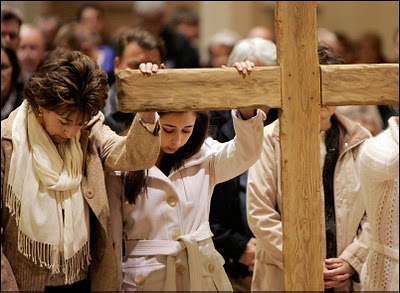
On Good Friday the veneration of the cross was beautiful. Person after person came up and kissed, or knelt and kissed, bowed, or placed a hand against the wood of a six foot cross standing in front of the altar. I pressed my lips to the side of the cross, foot level. When I returned to the pew and kneeled, I wept for the elegiac beauty of the ritual and the idea of living and dying for others. I felt the principle of self-sacrifice venerated—putting others before self—sacrifice for the sake of others. I’m sure my interpretation is not strictly adherent to the Church’s teaching, but the idea of being for others first is tremendously moving to me—more so than the idea of my eternal life being purchased by the death of another—though I’m sure that purchase of eternal life is exactly the point the Church would like me to take away.

I like to think I behave myself well, when I do, not because I’m afraid of Hell or jealous of Heaven, but because it’s the right thing to do. I don’t need metaphysical ransom to behave myself, which isn’t to say that I don’t often resemble the old lady in “A Good Man is Hard to Find:” if there had been someone there to shoot her in the head every day of her life, she would have been a good woman. Though, in my defense, the realization that we’re all equally beloved isn’t quite as hard won for me.

At the Good Friday mass, the priest lifted the bowl of communion wafers and I felt a burst of energy—imagine a tiny chrysanthemum firework going off silently and invisibly—the brown felt hat without the brown, the felt, or the hat shape. The small burst’s locus was the glass bowl of wafers. It came and went as fast as a flash bulb. My chest tightened. I took a deep breath and questioned whether or not the experience was real.

Was it real? If that’s what it feels like for the spirit to descend, what does it feel like to take communion after the spirit has descended into it? Had I experienced what I thought I experienced? Did I need to revisit my Prozac prescription?

Easter Vigil mass is when the Catechumen are baptized, the candidates confirmed.  The Vigil is the mass of first communion for all RCIA students. Easter Vigil is a long mass with nine readings tracing communion from Genesis forward.  The Vigil mass begins in darkness, lit only by the candles the Priests and congregants process in, lit from a bonfire outside in the Mary grotto. The congregants sit with their candles and the altar attendants light the Pascal and other two candles. The procession includes an incensory, and the air is thick with sacramental smoke. We sit in darkness and listen to the readings and choral responses.

In the liturgical year, Christ rises during the Easter Vigil mass. When the mass readings reach the risen Christ, the carillon chimes, a bell is rung, and all the house lights come up. It is a gloriously theatrical moment. I am fully present for the beauty of the ritual.

The Catechumen are baptized in the baptismal font—most by full emersion, kneeling in the water, their faces pushed into the water three times, in the name of the father, the son, and the holy spirit.  (Some only knelt while the Priest poured holy water from a pitcher over their heads in three draughts. Baptism by full emersion is optional.) The Catechumen exit to the conference rooms to change into Sunday clothes.

While the Catechumen change their clothes, the Priest blesses the congregants and the choir sings.

When we are all seated again, we are called up to the altar to receive anointing with Chrism as full members of the Catholic Church, our confirmation. (Chrism is oil— mostly olive, blessed by the Bishop and scented with sandalwood, patchouli, and floral notes. It is both dark and smoky and light with flowers. It smells wonderful. I intend to ask whether I can have some of last year’s batch. It smells that good. I’m a consumer of high-end perfumes, and this stuff is . . . wait for it . . . heavenly.) My husband introduces me to the Priest; I present my wife, Cave Mouth with the saint name, Dorothy. (There are two martyrs named Dorothy, but my Dorothy Day has not been officially canonized. Shhhh, it’s a secret.) The Father spreads Chrism on my forehead in cruciform, says some things, and we hug.  I experience a moment of pure happiness.

I am now a Catholic.

The mass continues with the consecration of the host.  (There is a moment in the liturgy when the Holy Spirit is supposed to descend. At that moment a bell used to ring. I’m not sure I felt the spirit descend at those times or not, but I don’t think it matters.) When the Priests outstretch their arms in a pushing gesture to bless the host, a rush of energy blows down the tops of their arms and from their palms toward the altar.

There was nothing to see, only the experience of an animated presence.

This time, I am certain of what I am experiencing. It is more than enough. Actually taking communion now seems beside the point, but I do with some amount of expectation. The wafer is simply a wafer in my mouth. The wine surprisingly good—much better than the crappy grape juice they serve at Methodist communion. I feel I have had my miracle, and I have no room to complain.

On Easter Sunday the candidates and Catechumens are no longer. We are Catholics. We take communion with everyone else. Unlike the Easter Vigil, which seemed to be attended by only the RCIA people and their guests, the Easter Mass is packed, standing room only. One of the three altar candles gutters out under the weight of the brass follower. When the Holy Spirit descends this time, it is perfunctory, a quick poof and gone.

Clearly, I have lost my mind. Maybe I’m not merely depressive; maybe I’m manic-depressive! Maybe I’m just flat out nuts and need to rethink my absence from the couch for the last decade. I don’t feel crazy. But not feeling crazy is a sign of genuine insanity, right? As long as I was fretting about being sound of mind and body, I was ok. Since I no longer obsessively fret…

With a deep breath to gird myself against my embarrassment and fear that I have lost it completely, I share this experience with the RCIA class at our regular Tuesday night meeting. The director offers reassuring information: people report light falling on them and all sorts of phenomena during the process. I am relieved:  mystical phenomena are part of the program. Ritual exists to occasion precisely this sort of experience. Sure, there are scientific reasons rituals produce results, but I’m not convinced that an explanation based in the sciences, hard or soft, matters. The experience is the experience. Crazy or not.

My friend Amelia, a yoga instructor and Buddhist, wants a debriefing mid-week. I tell her, I sensed the descent of the Holy Spirit. I think I have lost my mind. She asks if she’s ever told me about her Kundalini rising. When her Kundalini rose, she kept touching the top of her head to make sure it was still there: She felt like her head had been replaced with a swaying lotus bloom. Further, the corollary of confirmation for Buddhist is "taking refuge" in the Buddha, the Dharma (the teachings) and the Sangha (the community of Buddhists). When Amelia took refuge, the instructor blessed the graduating class and the air was so thick and electric with blessing that the rice she threw on the yogis danced in the air around them. No, Amelia said, you aren’t crazy; it’s real.

Light from light.

True God from True God.

Easter lasts eight days. It is a liturgical season like Christmas and Lent.

When I return to church for my first regular mass, still during Easter, I have a trembling feeling about taking communion. I’m afraid because suddenly it’s a really big deal. (We’re sitting out in the Narthex because our children are free-range and cannot be relied upon to sit still for any length of time—high energy, spirited girls.) This vague and dull terror is irrational. Still, my chest is fluttery as I make my way down the aisle.

Father R smiles brightly as he holds up the wafer: The body of Christ. I bow my head. (I like that he seems to take pride in our conversion and seems genuinely fond of me—even though, as you have likely guessed, I was the kid at the back of the room who always had another question.) I have made an altar of my hands for the wafer. When I put it in my mouth, the wafer itself seems to have the properties of wafer, but my chest is still fluttery scared and it seems extra important to remember to cross myself after receiving it. (I forgot to cross myself at the Vigil.) As I make my way back to the narthex where the families with kids who can’t sit still sit, the trembling feeling remains in my chest, but also I feel a light—basketball sized and glowing. Kneeling seems like a very good idea at this point. I pray. Hard.

For the life of me, I can’t remember what the prayer was; maybe it was just communion with the spirit.

Light from light.

True God from True God.

One in being.

In the car, I tell my husband about my experience. I tell him, I must be half-crazy. His answer is, Yeah, but it’s the good half

Aw, I think, that’s one of the reasons I love you.

Sunday, April 11, 2010

Further Negotiations: There’s Something Stupid in Every Religion –or- That Guy and Other Dumb Stuff


When my husband and I were arguing about whether or not our daughter and I would be attending The Shambala Center in Berkeley, California, my Buddhist friend Amelia wanted to know how I could possibly believe in all the stupid stuff associated with Christianity: The stories are predated by remarkably similar stories in other cultures and faith traditions. The idea of a red devil with pitch fork and horns. The elaborate accounting and jailhouse that is the Catholic afterlife of Heaven, Purgatory, and Hell, in which numbers of prayer hours net years off one’s sentence.


[Editor’s Note: Amelia respects Christianity and the beliefs of Christians. She believes the purpose of religion is to help varieties of people reach an understanding of God.  As a Buddhist, she believes Jesus is a guru among the many gurus—a great teacher who has lead countless billions to a deeper understanding of God. She does not believe Christianity is stupid. Our conversation related here was not a serious one, but another moment of irreverent levity in many we have shared in the overall context of a great respect for one another’s beliefs. Obviously my memory is subject to the vagaries and unreliability of memory; Amelia tells me that dumb guy is a she, not a he.]

At that time in the bookstore of the Shambala Center, there was a print or painting of a demon with a mouth full of huge fangs hung near the ceiling above the bookshelves. To me, it looked kabuki—curling graphic stripes of primary yellow and red, with that odd jade green and gilding particular to some Asian art.  I had asked Amelia about it. Who or what is that?!

She had answered that it was the demon who in the afterlife rips the jugular from the perverters of the dharma with his long, frightening fangs.

In response to her questions about how I could believe that dumb stuff, I asked, Oh really?! What about that guy?!

This response seemed to satisfy both of us.  There’s something stupid about every religion.  

There is an element of superstition and the bizarre to every faith practice—the compulsion to cross oneself when an ambulance passes, my mother-in-law’s panic around our slowness in getting our children Christened (as if any God we believed in would condemn the souls of babies to anything less than Heaven), fish on Friday (as if fish weren't meat), vampiric demons, dietary restrictions, those weird Ayurvedic practices involving cleansing internal cavities of one sort or another (with all due respect to the netti pot, which must certainly be a Divine gift to those with sinus issues). Any one practice, any one idea, any one story taken out of context can be held up to ridicule.

Then and now, my feelings are these:

1.     It isn’t important what I think; it’s what I do.

(That’s a challenging precept for me. I’m all about language. The best gift I have to offer is my ability to write. Sure, I can bake cookies, I can show up for the St. Vincent de Paul warehouse weekend, I can write checks, I can volunteer for all manner of civic and church events, but the first fruits are right here. Writing is an intellectual exercise. Sure, I try to work from trance, to leave myself a vessel, and otherwise attempt to be a conduit, but my brain is all over this. And the brain is a dangerous organ because it can be convinced of anything. It’s the heart that tells the truth. Is writing doing or being? At the least, I try to make writing be about being. For much of my life, it has been while writing that I am closest to purely being, which is one way to know I am following my bliss—or living an inspired life— or following a greater plan.)

2.     It is important for me to have a faith practice, more important than having faith.

Faith is good, but without practice what is it? I say religion that is merely belief is superstition.  The Church Lady has no faith practice beyond attending church and praying. She certainly doesn’t treat other people with Christian charity. I’d be willing to bet she doesn’t vote with the common good in mind either, but with a preference for punishment and judgment. Practice, though, practice creates a change in my self and the world that is demonstrable. It is the thing I can point to when people ask, what’s the point of religion?

The point of religion is the practice of compassion, forgiveness and love in one’s interactions with the world. Feeding the hungry. Comforting the sick. Loving one’s neighbor as one’s self.

It is through the discipline of faith practice that I most easily experience the divine.

The Catechism and the Nicene Creed (which Catholics repeat during most masses) feature a belief in the afterlife—“we look forward to the life to come”—and when most religious talk about their belief, they eventually wend around to “eternal life in communion with the Father and the Saints.”  I wouldn’t mind that; it sounds great. The afterlife does not motivate me. What kind of person would I be if that were my sole motivation?

I like to think most people chose to be good because it’s the right thing to do whether there’s a reward involved or not. Sure it’s a good thing to return the lost wallet for the reward; it’s an even better thing to just return it because you can imagine how you’d feel if you lost your wallet. I don’t need a reward. I just want everyone to be happy and kind.  It would be fine with me if I died and nothing happened. Especially if I knew I’d lived a good life.

3.     The practice of choosing to believe in those things that blow open my heart to an experience of myself as part of a mystery bigger than myself is a good thing. If a belief of one sort or another guides me to a better, healthier, more authentic version of myself, it’s a good thing in which to believe. So, while I have yet to memorize the Nicene Creed, I say it along with the parish in the hopes that— in choosing to believe— my rational mind will eventually catch up with my heart.

4.     Prayer works. Every specific request I’ve made has been granted—to my surprise and embarrassment.

I’m surprised every time a prayer is granted, even though I know beforehand that, so far, God willing and knock wood (yes, I'm aware of the irony), I’ll get that for which I’ve asked; all my previous petitions have been answered in the affirmative.

I’m embarrassed because belief in supernatural phenomena (prayers being answered) and interaction with supernatural entities (talking with dead relatives or asking God for stuff) are activities most often shared by paranoid schizophrenics and manic-depressives. (To the best of my knowledge, I am merely depressive.)

Five years ago we were living in a dorm room with our two-year-old daughter in the San Francisco Bay Area. Beloved had taken a tenure-track job at a school just east of the Caldecott Tunnel. We drove through The Canyon and dreamed of a cabin in its dense wood. I pored over real estate listings and found a property we could afford if I went back to work. It was an hour further outside the Bay Area proper. A cute little early twentieth century house with a huge lot by California standards. It was 600 sf and had no closet. Not even a broom closet. It cost $250,000. There was no lawn. The house next door had two threadbare sofas on the front porch and a car on blocks at the curb. On that weekday afternoon, several men who didn’t look like college professors or industry types sat on the couches watching us warily as the realtor showed us the house.

(Like many Americans at that time, we were deep in debt and had no net worth; in fact, our net worth was over fifty grand in the red. We wanted to own a house because we had a child. We were tired of paying out thousands a month on rent and not accumulating net worth. One of the reasons we were so strapped was a stubborn refusal to live in neighborhoods in Los Angeles that we could afford. If one only lives in accommodations costing less than thirty percent of one’s income in Los Angeles, one will be living in a neighborhood in the Valley, which is not Los Angeles, or in South Central, which is not very safe. )

In January, my husband swore we’d have a house by the end of the year. To create good karmic cause for a house, he organized a school-sponsored Habitat for Humanity build. He said there was no way the Universe would give us a house, if we didn't help other people get houses. For my part, I prayed for a house every Sunday during mass.  We closed on our house in September of that year.

Sure, it isn’t definitive proof, but what is? I like to think the Universe moved to answer our desire in the affirmative because we humbly asked for what we wanted and took steps to get it—all on terms the Universe probably is more likely to understand and value.


Thursday, March 18, 2010

Further Negotiations: Fall-ing in Love


People still talk about our wedding: The best party they’d ever been to. The most moving ceremony. (Our prayers, the only part that could be truly individualized within the Rite, were especially moving for some of the guests.) The most enjoyable reception. The most heartfelt and meaningful toasts. A magical night. Fun. Truly an expression of us as a couple.

The Rite of Marriage was observed at Sacred Heart Catholic Church in the early afternoon of Halloween. A masked ball, the reception was held that evening on the back lawn of the University of Redlands Alumni House.

My paternal grandparents were already gone; they had died within months of each other in 1993. The extended family all wished they could have been there, even my mother who as the ex-wife of their son and my father, hadn’t spoken to them in a dozen years. My cousin, Kathleen, a good Catholic woman, said she could feel them there at the reception, smiling over us.  I didn’t feel them there, but Kathleen wasn’t the only person who told me they were thinking of Grandma and Grandpa.

(I just felt good, awash in the swirling magic of a romantic evening—Italian lights in the big live oaks around the dance patio and the pergola; paper lanterns in the trees; candle light flickering over everything; champagne and dancing under the warmth of a Southern California autumn night sky.)

The problem with awe-inspiring weddings, priests are fond of reminding congregants, is that couples focus on the wedding and not on the marriage. Catholics speak of discernment a lot. Couples ideally should discern whether to marry one another. Discernment, as far as I have been able to gather, is prayerful decision making. I imagine that a person who is in the process of discerning, prays and meditates and waits for inspiration as to the correct course of action.

A brief perusal of Wikipedia and on-line Catholic Encyclopedia yields this paraphrase: discernment is between those spirits or angels who entreat us to join them in obedience to god’s will and those spirits or angels who entice us to rebel with them against god’s will. Within ourselves, the lower levels of consciousness, of the flesh, growing out of the fall, entice us away from god’s will.

In 1990, several weeks after meeting my husband in the men’s room at a graduation dance (that’s where the keg was being hidden), I was an odalisque on the turquoise Naugahyde sofa of an efficiency hotel room near Northbrook Illinois. My husband and I were staying there, as his mother, a good Catholic woman, would not allow me to spend the night in their home. We had spent the last twenty-four hours in bed. We had seen spots. We had been dazed. We had seen God.  My husband, fleshy and recumbent on the bed, asked me if I wanted to have children. Technically, this was our second date. I said, yes.

That we would marry one another was a foregone conclusion pretty much from the first kiss on. When we met, we spent the remainder of the weekend together.  The morning of the men’s room/keg night, I told my mother that I had met the man I would marry.

Many years later, the year my paternal and beloved grandmother died, my beloved and I were en couchant when I sensed someone standing in the doorway to the bedroom. There was no physical presence there when I looked, but I knew it was my grandmother up near the ceiling. Grandma! I thought fiercely, this is not a good time.  I was mortified. (har har har.) She thought back at me, It’s ok. I like him. He’s a good match. Blessings. Her message wasn’t conveyed in language—more like sending the energy of goodwill with specific intentions. And then she was gone.

That is my experience. It is true. And in it lies the kernel of another conflict I must negotiate. (Catholic teachings acknowledge the existence of souls, the tradition of living humans talking to dead spirits, most notably in our petition of the saints. I see dead people and the Church is cool with me talking to my dead grandma.) No, the problem is that in my metaphysics, flesh and sex and lust and romantic love aren’t an evil to be overcome, but a joy to be celebrated. (Cue up Sly and The Family Stone’s It’s Your Thing.)

Sometime after I wrote my letter to the Bishop, my husband and I met with the parish priest at the Catholic Church in my home town a two hour drive east of Los Angeles.  We were there to take a compatibility test. We took our test booklets, Number 2 pencils and ScanTron bubble sheets into separate rooms, and spent the next forty-five minutes filling in bubbles with graphite in response to questions like “have you ever engaged in sexual activity with a member of your own sex?”

According to the ScanTron test, my answers raised several “red flags”—divorced parents, less than a Kinsey 0 heterosexual, no strong faith tradition.  I am a sucker’s bet as marriage material.  (Maybe the Church screens for perfect 0 heterosexuals and thus has a constituency that is naturally inclined to favor an ahistorical, literal read of the Leviticus dictates? Just a thought.) Our officiating priest sternly told us that the test results did not predict a successful marriage. (My husband denies that this happened: Not to my recollection, he says, in the same tone his mother uses when she says, Oh, I don’t know anything about that, which means, I’d rather not do that and I’m not going to. In his language it means that he will not tolerate a less than romantic version of the story of our courtship, betrothal, and eventual marriage.)

I remember Rich responding that there was nothing the test could tell him about me that he did not already know, and then a pregnant pause while the priest waited for us to change our minds, call the whole thing off, at least postpone.

The priest rubbed his hands on his knees and inhaled deeply.

So, I suppose we should discuss the ceremony, he conceded. Rich told him about how we planned to name our first child Rilke, boy or girl; how we had felt God in our relationship from the beginning; how we are matched as friends, lovers and spirits; how fond we were of Rilke’s Letters on marriage (two bordering solitudes); how he felt he had seen God in the Face of Love I had shown him.  (I’ll have to remind myself to read this paragraph when I’m looking at a table full of cereal bowls no one could be bothered to bus for themselves: He’s not just that annoying guy who leaves his socks everywhere.)

There were lots of questions on the test about whether we were worried about the cost of the wedding, whether we felt the reception was overemphasized. I remember answering no. We had a budget. Sure, we’d overspent a little here and there, but the point of a wedding, we agreed, was the public affirmation of what is essentially private and unknowable—a mystery to outsiders. The wedding wasn’t really for us; it was for our friends and family. The wedding was meant to invite a celebration of that mystery. (Admittedly, the wedding party table was the only one to be served from a bottle of Dom Perignon, and we dispensed with those parts of the tradition we found tedious—no receiving line.) On a purely pragmatic note, I told more than one person, even if you believe marriage is an arcane, outmoded arrangement concerned with inheritance and property rights, it is for those reasons alone that one should marry before breeding, and we were ready to breed. That’s why you “make it legal” or “get married,” right? To fornicate and be fruitful in the context of social, legal and economic stability.            

On a summer afternoon in New England in the early 90s, I officiated the wedding of my friends Mary and Matt. Matt had paid the twenty bucks and done the paperwork for me to become a pastor in a likely evangelical and definitely mail order church.  My homily went something like this: We are gathered to formally acknowledge a marriage that has already been lived in the hearts and bodies of Mary and Matt. There were elaborations, examples, flowery musings on marriage being a vow made in the heart language of a couple and the fruits of its expression being all that others are able to witness. That was the central talking point.         

It is probably because of my husband’s shared belief in such ideology that he feels he can “call” a marriage. Every ceremony we’ve attended, every newlywed couple we’ve encountered—at some point he leans in and whispers, I give it ten months, two years, or simply, This one’s doomed. Or, This one’s a keeper.     

You’re either married in your hearts, or you aren’t and no amount of paperwork, Church or civic, can increase or decrease your commitment to one another or the institution. We all know people who while married, hold in the institution and their partner in contempt. Equally, we all know people who hold the institution in contempt but live together in what for all intents and purposes is a loving marriage for multiple decades. Think of Susan Sarandon and Tim Robins. My husband and I for the first eight years of our relationship.  All the gay men and women of a certain age who met one another before the era of same-sex marriage, and who twenty plus years later are still together.                       

Decisions that grow out of our debased, fleshy nature. Hmm. While I will confess to the sin of gluttony, I have a hard time believing that the fleshy union of my marriage has anything to do with an absence of God or a retreat from God. I have every reason to believe that this relationship was anointed long before the Father at Sacred Heart knew we existed. Not only did Grandma come back from the dead to bestow the blessings of The Universe on our union, she picked her moment.